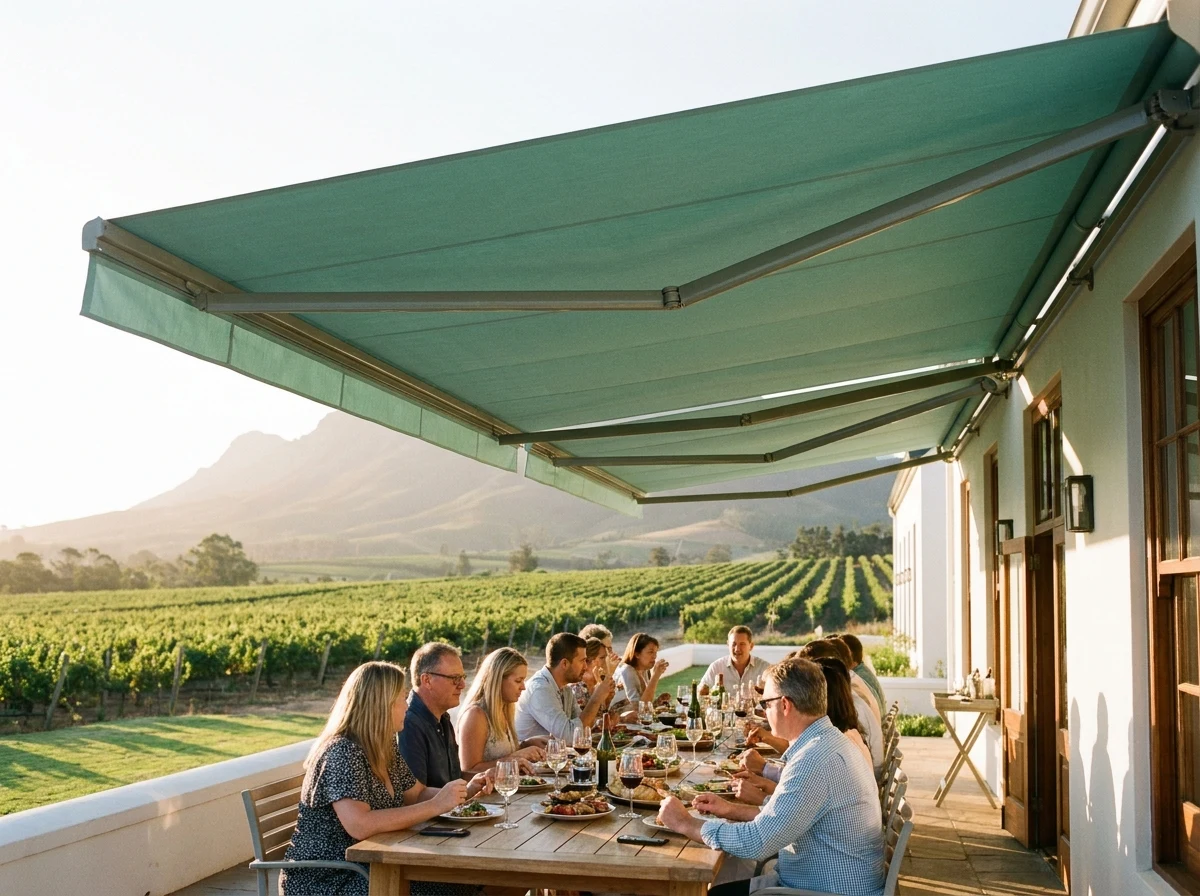
A north- or west-facing patio bakes through a Boland summer, especially once the afternoon adds Paarl Rock's reflected heat on top of direct sun. A folding-arm awning turns that same patio back into a usable room in minutes — and retracts fully in winter to let the low, welcome sun back onto the stone. No posts means no interrupted vineyard view and no obstacle in the braai space.
An awning is a shade product, not a rain product — it handles a light drizzle at a pitch, never standing water or a proper Cape downpour. Wind ratings are real limits, not suggestions, and the fixing substrate (brick, timber or steel) needs checking on site before we quote projection and width.
Wide, motorised runs shade the entertaining terrace on golf and wine estates like Boschenmeer; family patios in Denneburg and Courtrai usually run a single crank or motorised unit sized to the braai area. On the older, closer-set stands of Noorder-Paarl, a semi-cassette keeps the frontage tidy when the awning's retracted.
The guide runs by the square metre of projection, installed — the shade thrown across the patio, not the wall width behind. Crank-operated: R3,500 to R5,500, an open or semi-cassette mounting cheapest and a full cassette, shutting fabric and arms away from summer dust and winter rain, dearest. Put a motor and a wind sensor on it and the range is R5,500 to R7,500.
In a valley that gets real wind the sensor is a specification decision rather than an upsell — an awning left extended in a gust is the one that has to be replaced. Compact awnings attract a minimum, since brackets, arms and crew do not halve with the projection. An old farmhouse fascia sometimes wants a fixing detail a modern brick wall does not. Measured free, then priced in writing.
Ready when you are
Send the form and one of our expert consultants will contact you shortly to arrange your free in-home measure.
Request my call-back →