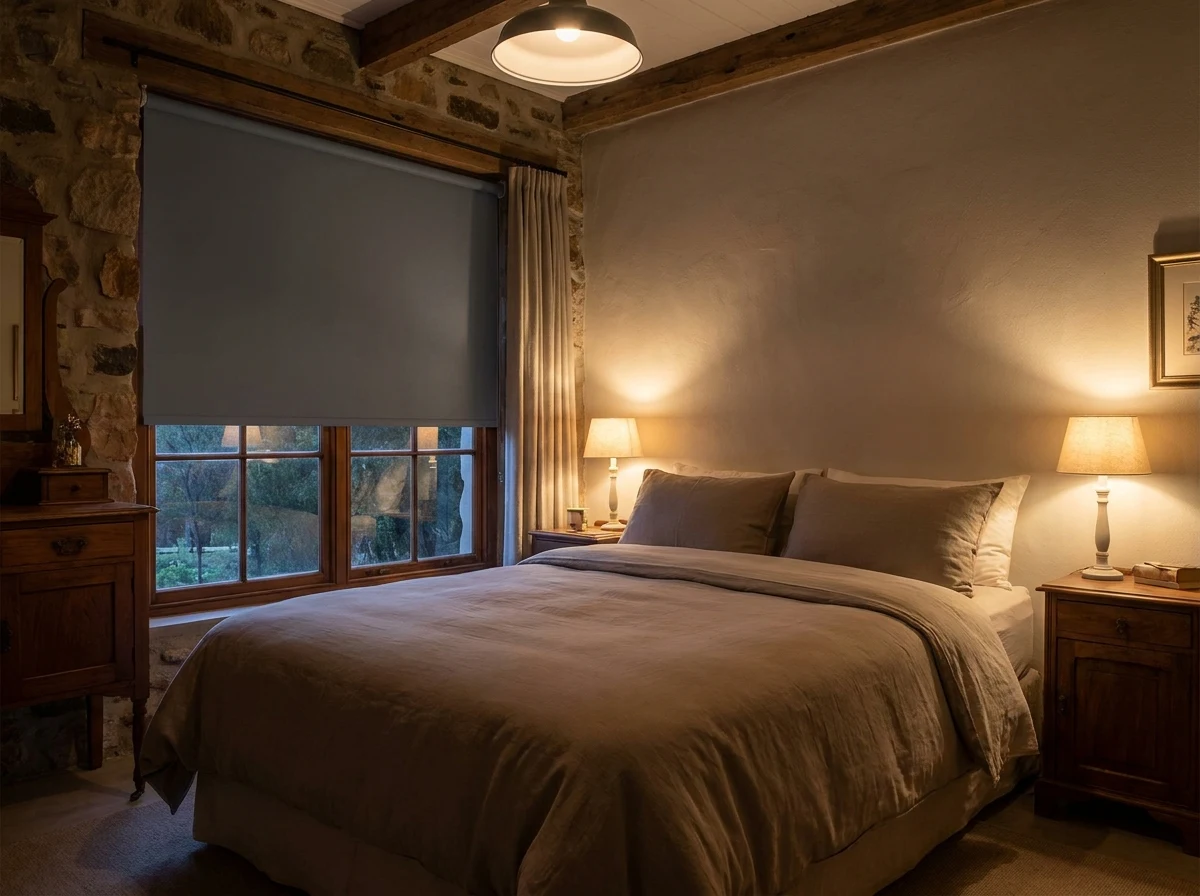
A roller is one tube and one flat sheet of fabric. That plainness is the appeal — and it is also why the fabric choice carries the whole job, because there are no slats to tilt and no vanes to angle later if the call was wrong. The same product often gets specified three different ways in three rooms of one Paarl house.
So we work window by window. Which elevation is it on, what happens in the room behind it, and does the mountain reach it after lunch?
An open weave tight enough to knock down glare and UV while leaving the vineyard rows, the fairway or the garden readable through it. Openness is quoted as a percentage — 3%, 5% and 10% are the usual ones — and the lower the number, the denser the weave and the more it takes out. Rooms on the mountain flank of town generally want the tighter end, because they catch a second helping of afternoon heat bounced off bare granite well after the sun itself has swung west. A room already sitting under Courtrai's mature trees can afford 10% and keep more of the garden.
One caveat we always raise: the daytime privacy a sunscreen gives you reverses after dark. Lights on inside, and the room becomes the brighter side of the glass. Bedrooms facing a street or a neighbour want a second layer behind the mesh.
Coated fabric, no light through it at all. Bedrooms, nurseries, media rooms, and anywhere an afternoon sleep through harvest heat is the actual brief. It doubles as a thin insulating layer, which counts at both ends of the year here — against a February afternoon that refuses to let go, and against a wet valley night in July.
The middle ground. Daylight arrives softened, the view does not arrive at all, and nobody outside sees in. Bathrooms, a guest loo, a Denneburg kitchen window three metres from the neighbour's wall.
A double roller carries both fabrics on a single bracket — sunscreen down through the day, blockout drawn over it at night. It is the standard fix for a bedroom that wants the vineyards at seven in the morning and full dark at nine at night. The constraint is depth: two tubes need more room in the reveal than one, which makes it a tape-measure question rather than a catalogue question.
A single roller runs to roughly three metres of fabric before the tube begins to sag mid-span and the blind stops hanging true. Past that, there are two routes: split the opening into two blinds with a deliberate join lined up on a mullion, or link motorised blinds so they travel together and the join disappears into the operation instead of into the view. On the wide glass that Boschenmeer homes turn toward the Berg River and the course, that decision gets made at the window with the mullions in front of us, not on a spec sheet afterwards.
Rollers are not the right answer everywhere in this town.
On the deep-set sash and gable windows in Noorder-Paarl's older streets, a timber venetian sits better beside period joinery and copes with a reveal that was never built to a factory size. And where a room is genuinely overheating rather than simply glaring — the classic mountain-facing lounge from about three in the afternoon — fabric on the inside of the glass is fighting heat that has already arrived. External venetians or a roller shutter outside the glass do more for that room, and we would rather say so at the measure than sell you a blind that disappoints in February.
On golf-estate glass in Boschenmeer, a low-openness sunscreen holds the fairway and the river in view while taking the reflected load off the room. Garden-facing bedrooms in Courtrai mostly go blockout, with lighter fabric on the elevations the old trees already shade. In Denneburg, where the question is usually a whole house on a fair budget, we sequence it — children's rooms and the west-facing lounge first, the rest when it suits. And in Noorder-Paarl, rollers tend to land in a newer rear extension while the street-facing rooms keep their timber.
A guide, worked by the square metre installed. Chain or spring rollers in blockout, sunscreen or a light-filtering weave price at R1,000 to R1,600 — plain blockout cheapest, and a low-openness sunscreen on vineyard-facing glass, or a double roller holding both fabrics, dearest. Motorised, the guide is R2,500 to R3,800 with the tube motor and its control counted.
Two things bend that here. Tiny openings attract a minimum instead of an area rate, since bracket, tube and labour hardly change with the pane. And a wide farmhouse opening needing a linked pair rather than one impossible span shows that as its own line. Ranges, not a quotation — each figure is worked out after the free measure and written down.
Roller questions
Every blind is cut to your openings, so there is a manufacturing gap between the two visits. How long depends on the fabric and whether motors are involved, which is why the lead time is confirmed in writing on your quote instead of guessed at over the phone. Nothing goes into production until you have accepted that quote.
Both are fine, and for a full house we often suggest the second. Rank the rooms by how much they irritate you — the lounge that takes the afternoon, the bedroom nobody can sleep in — and start there. The measure covers every window either way, so you get one itemised quote, and the exact fabric and colour go on file so a later phase matches the first rather than nearly matching it.
Any fabric fades under strong sun eventually; on the granite-facing side of town it simply gets more of it. Two things help. A denser sunscreen weave takes more UV before it reaches the room, and a lighter colour absorbs less heat than a dark one, which is kinder to the fabric and its stitching over the years. Where a window takes direct and reflected sun together, shading outside the glass spares the fabric as well as the room.
Nobody, in practice — which is the argument for motorising that one. A rechargeable battery motor needs no wiring and no electrician, so a single high window can go motorised while the rest of the house stays on chains. Mention it at the measure and we will spec a motor the later ones can join, so a second remote is not needed if you add more.
Ready when you are
Send the form and one of our expert consultants will contact you shortly to arrange your free in-home measure.
Request my call-back →